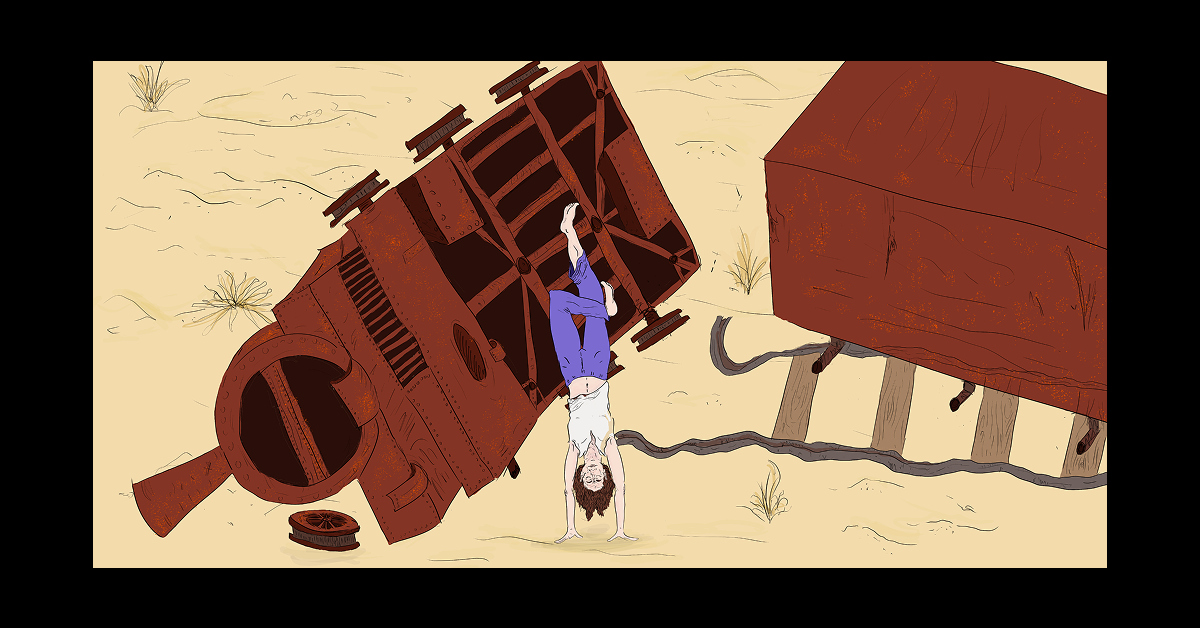
In the middle of the desert, there is a train that goes nowhere.
“Tickets please!”, says the young woman with the eyes of an old lady. She guards the entrance to the wagon, which is said to be haunted.
I gaze down to the hem of her skirt, the intricate embroidery as red as her lipstick. “We must sometimes appease the expectations; you will understand shortly,” she explains.
On her shoulders rests a keffyeh; it is not black and white. Old Eyes hears the question in my mind and clarifies: “For the sun.”
She lets me on, and from inside comes a voice: “What’s all this then?” Once I’ve hoisted myself up the step and let myself into the musty carriage, he eyes me up and down. His cocker spaniel anticipates his disapproval with a growl. With an upturned nose and a wiggle of his moustache, the phantom voices disappointment at the bare cotton of my t-shirt, my denim clad legs and the scruffy sneakers on my feet. Pulling at his red tie he asks that I exit and try again. I am not here to argue; I poke my head out the door, and Old Eyes beckons me back out. Old Eyes hands me a plain abaya, an embroidered thawb, and, after looking left and right, up and down, slides her keffyeh off her shoulders and hands it to me, folded into a big triangle.
I can’t wear all this together, can I? I understand from her that I am to slip into the thawb, drape the abaya over it, and use the keffyeh as a headscarf. “To appease Mark’s expectations.” She says.
After a slow appraisal in the hot, desert sun she finally lets me into the musty carriage, “Right, then”, He says, pleased smile revealing a row of yellowed teeth. He pulls at his red tie again as he studies my face.
“Can’t do anything about your complexion, can we now. Too milky for my taste.”
He wishes peace upon me, or at least I think he does. I remain by the entrance, my legs heavy.
He slithers out of his auburn coat. “My father, Tatton, was an eccentric, you might say. He was obsessed with keeping his body temperature at a precise 36.5, slipping in and out of his overcoat as the thermometer dictated.” He seems eager to chat, but it is clear he has not spoken in a long time, his throat dry and his Ts fickle.
“You mustn’t complain, see.” I notice his tongue rise as he points to the red crayon by the ashtray. “The map was in the hands of its author.”
“I know what you want to say. You mean to tell me that secrecy alone implies guilt. Well I must say I do not agree. When you reach maturity, something I hope my help enables you to do, you will yourself be faced with such decisions, and you will understand how tricky they are to finalise. The Czar didn’t mind. You must put things into perspective.” He gets up, paces around the carriage.
“All of the noise you’ve made about a silly letter. Well, you can only hope that one day your correspondence would be taken as seriously as the law. Arthur loves to chatter. And I can assure you it was never about the oil.” He ignores me when I bristle at his snide replacement of the loaded word “declaration” with the innocent term “letter”.
Swinging his legs back and forth, he continues: “Even you can understand that this train was countryless. There was a train that went from one country to another, but no train that served two neighbouring villages! It was just a train from here to there. It did not understand who it served and where it was supposed to go. Can you imagine, now, an uninterrupted flow in and out of the brown area? With no questions asked?” He tuts as though it was me who had protested. “It was a train full of thieves. Hour-long journeys took days. Without horses at the stations, you could get nowhere.”
On my way out, letting myself drop back onto the sand, I come face to face with Old Eyes’ hem. The embroidery had cheated me: the cross stitching, upon closer look, appears to imitate the shape of a poppy. I look up, searching her irises. Through a placid smile, she repeats: “You’ve appeased the expectations of your own free will. Don’t ask again.”
*
Left in the dining car of the desert train:
a brown crayon, an untouched bilingual dictionary, and a very opinionated essay with no references
*
In a triangle flanked by mountains rests an unmoving tram. Its door is ajar and adorned with a gushing introduction: THE SPECTRE OF FRANÇOIS-GEORGE HAS CHOSEN TO SPEND ETERNITY WITHIN THESE WALLS. LONG LIVE THE SPECIAL FRIENDSHIP BETWEEN OUR TWO COUNTRIES. The badge carrying the words glimmered against the dirty unkempt door, as though it were someone’s task to shine it daily, the door never replaced nor maintained.
I was told that this tram was once unhaunted, that it was not always unmoving. Not long ago, it spanned from the lighthouse to the oven’s window. My journey here did not take long, yet I needed to run up to the clouds for a few minutes and scurry back down, rather than cross over on foot. I had travelled from dryness to humidity and I hoped not to have to forego the soft cotton of my t-shirt. When I pushed the door open, he was a little bit confused, but made no requests concerning my wardrobe.
“Oh pffft”, is all he says before asking for identification. “Only to make sure”, he offers placatingly. He lets out a sigh of relief when I address him emphasizing the end of every word.
He takes a deep breath as he grabs the blue crayon. He explains that not all désastre is the same. On the walls of the carriage he draws a majuscule D and a minuscule d. He tries two different seats before settling on the floor, where he strokes his poodle the way a cartoon villain would a cat.
“It is not as pronounced here; see, you must understand, you do not have the worldly infrastructures.” He crouches and whispers loudly at the room: “You don’t even have trains. You must understand the difference.”
His fingers slide into his hair. He pinches a single strand and, with a grimace slowly wrenches out a louse; he crushes it on his thumbnail, visibly satisfied by the popping sound. “We are alike in that I also carry my father’s name nestled between my first and last.” He gives me a smile I have so often seen, one that assumes I understand very little. “Well, we are not so alike… raaah mine is less patriarchal, perhaps, it was given to me by presidential decree.”
He is prepared for back-talk, and his face widens with surprise at the absence of lip on my part. “Our women are far more liberated”, he mutters. He asks me to do a front flip and a handstand; I oblige. He circles me, measuring my shorts and assessing the opacity of my shirt.
“Now I know what you want to say,” he wants to appear confident but has started stumbling on his words. “You mean to tell me that we cut you up and eventually dissolved our own lines. Well, notice my use of the word eventual – it was almost a century between the addition of your lines and the dissolution of ours. Lines, I say, I am being pernickety and generous at once. Have you ever drawn anything in the sand? Nothing so ephemeral. The lasting effects, I dare say, are not our fault.”
He appears irritated by his own argument and launches into an explanation of chronology and statistics. “And do not make things out to be so black and white,” he moans with an eye roll. “See everything that happened with the island and how their lines were, initially, invisible to some and rigid as metal for others. And how to all they are visible now.”
I shrug. He bristles.
“It was already red and blue. Or blue and red, I should say”, he teased with a sly smile. “Look at this carriage — is it not red and blue? As to the individual vehicles — don’t pretend you don’t enjoy them. We both know it is better this way.”
Confusion at my persistent silence overwhelms his slim and haughty face, hardening his features. “I don’t see any blood”, he says, delving into the supporting facts and figures.
At the end he gives a little smile and nods. He is letting my insolent silence go, because how can I know any better? Among my own I roll my Rs, I have never cast a ballot. On my way out I tell him that I am mesmerised by the waves; he assures me my time would be better spent watching a moving picture.
*
Forgotten by the entrance of the triangle tram:
another brown crayon, a bicorne, and a dull sword
*
There is an impossible train on an island, often hidden in murk and mist. Its mechanism is kept secret for this train does not travel on land; it swims.
A young girl settles into her seat and takes a box out of her backpack. It is a LEGO set. She begins to arrange the pieces, to make them easier to assemble later and orders a tea through a QR code.
To her right is a group of three men. They had seemed so deeply engrossed in conversation that she couldn’t help but wonder about the subject they were discussing. She focused a bit and the noise of their chatter became clear, but the meaning still opaque: they sound like screeching train tracks and passenger announcements.
A young boy wearing a dark lavender T-shirt rolls over to them and they greet him with the whistles of an old-timey train. Pulling on his T-shirt he expresses his excitement about the purple train, his exclamation giving way to a new wave of rail rustling and high-pitched tooting. She grows furious with jealousy, quietly attempting a “chugga chugga choo chooooo” for herself. The purple train boy glances at her briefly, and with a low rumbling sound turns back to the rail men.
*
Before she can lay one plastic brick on top of another, a waiter appears, holding a cockapoo by a leash. She stifles a laugh at his cerulean blazer paired with vermilion trousers. To top it off, a yellow belt snaked through the red loops. An outfit mismatched, like rails under water.
“Would you like to pay with our coin, or the borderless coin?”
She looks at her palm. “I can use your coin down here?”
The waiter shrugs. He taps his foot impatiently.
*
Confiscated from the young lady: crucial pieces from a Lego train set. She says she was trying to rebuild a railway abandoned in 1920.
The case against her laid bare the impropriety of her attempt: the region she wanted to connect had already been split between the red and the blue, with the brown area handed to “a people with no land”.
The undercover waiter with the rhyming top and bottom is both knighted and given a Légion d’Honneur.
Laila Obeidat
Laila Obeidat is an emerging writer and poet.